Manual Versus Automated Keyword Research for Scaling Content Production
Compare manual and automated keyword research for content scaling in 2026. Learn how SEO discovery automation helps founders and agencies dominate search results.
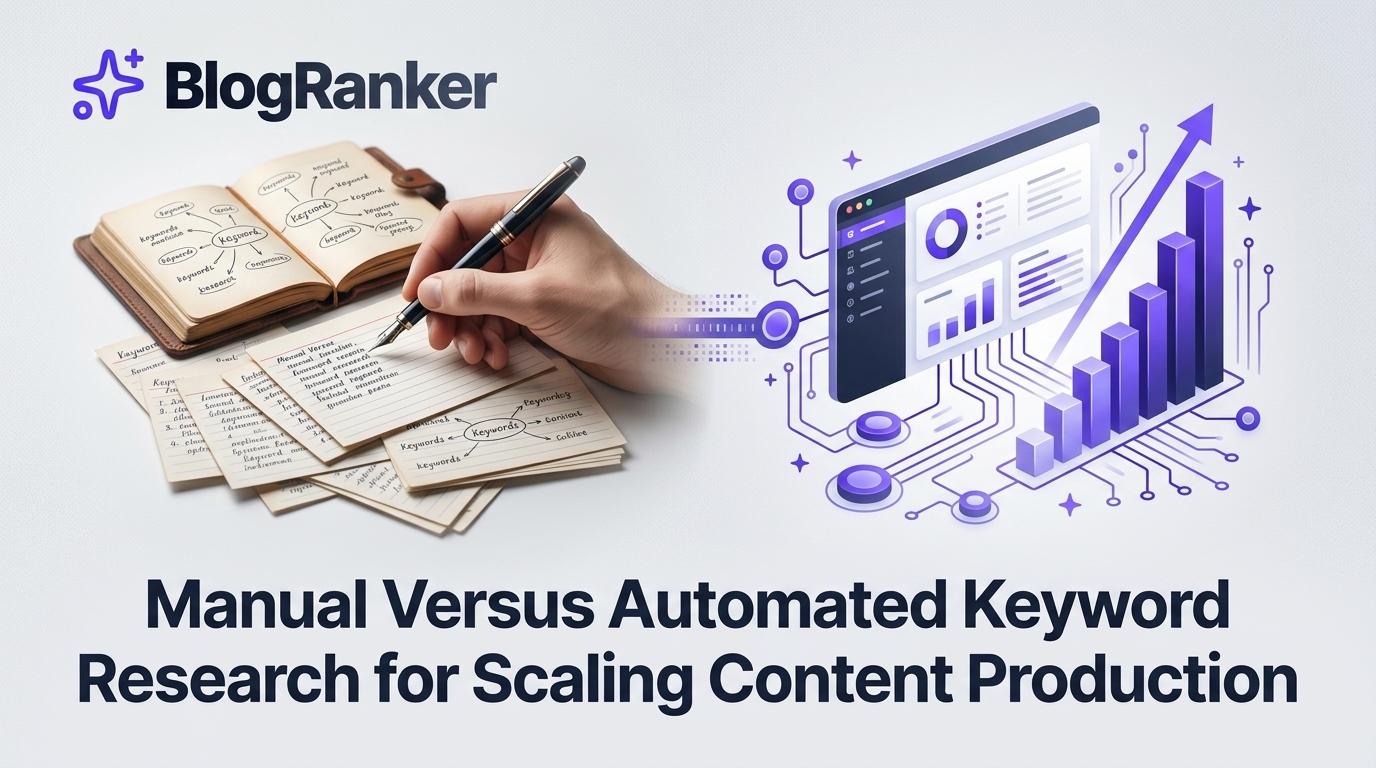
Scaling organic traffic in 2026 requires a choice between two very different paths. You can either spend dozens of hours every month hunched over spreadsheets, or you can use algorithmic systems to find winning topics in seconds. The gap between those who grow and those who plateau is often found in how they handle keyword discovery.
- The Traditional Approach to Keyword Identification
- Keyword Discovery Automation in the Age of Generative AI
- Comparison Table: Manual Versus Automated Workflows
- Accuracy and The Search Intent Gap
- Consolidating Your SEO Tech Stack for Maximum Efficiency
- The Role of GAIO in Modern Keyword Selection
- Scaling Content Production Without Increasing Headcount
- Frequently Asked Questions
The Traditional Approach to Keyword Identification
Manual keyword research used to be the gold standard for SEO professionals. It involves using a variety of tools to pull search volume, competition metrics, and trend data, then manually grouping them into clusters. This process provides a high level of control. An expert can look at a list and intuitively understand which keywords represent a customer in pain and which are just casual browsers.
However, the time cost is massive. For a startup or a growing agency, spending forty hours on research before a single word is written slows down momentum. This delay is why many are moving toward manual SEO tools versus automated content engines to see which fits their specific growth velocity. Manual work is precise but lacks the elasticity needed to dominate a market in 2026.
Visuals are also part of this slow manual process. Many creators spend hours finding the right stock photo or trying to prompt a basic AI for images. To see how specialized AI can speed up the visual side of content, check out Nano Banana AI Versus Midjourney For Generating Photorealistic Brand Photos to see how branding is also being automated.
Keyword Discovery Automation in the Age of Generative AI
Automation has moved beyond simple scrapers. In 2026, keyword discovery automation uses machine learning to predict which topics will trend before they show up in standard databases. These systems analyze social signals, forum discussions, and competitor gaps to hand you a list of high-intent opportunities on a silver platter. This removes the guesswork and the heavy lifting from your daily operations.
When you automate discovery, you are not just getting a list of words. You are getting a map of the market. Modern platforms can identify find high intent keywords that your competitors missed by looking at semantic gaps in their existing content. This allows you to build authority in niches that are currently underserved by the giants in your industry.
Advanced users often use specialized prompts to push these systems further. For example, some experiment with 14+ Grok Prompts for Creative Freedom and Advanced AI Experimentation to find unique angles that traditional SEO tools simply cannot see. Automation provides the foundation, but the right inputs create the edge.
Comparison Table: Manual Versus Automated Workflows
To help you decide which path fits your current business stage, here is a breakdown of how manual and automated research stack up in the current environment.
| Feature | Manual Keyword Research | Automated Keyword Discovery |
|---|---|---|
| Time Requirement | 10-20 Hours Per Month | < 30 Minutes Per Month |
| Skill Level | High SEO Expertise Needed | Low to Medium |
| Scalability | Linear (More work = More time) | Exponential (Set and forget) |
| Data Sources | 2-3 Keyword Tools | Hundreds of Live Signals |
| Intent Analysis | Intuition Based | Pattern Recognition Based |
| Cost | High (Labor + Tool Subs) | Low (Single Platform Fee) |
| Yearly Output | 50-100 Detailed Pieces | 500+ Optimized Pieces |
Choosing between these methods often comes down to your budget and growth speed. If you are comparing platforms, you might find the breakdown of ChatGPT vs Google Gemini for generating high ranking SEO keywords useful for understanding how the core LLMs handle data differently.
Accuracy and The Search Intent Gap
A common argument against automation is the fear of losing accuracy. Critics suggest that an AI might choose a keyword with high volume but zero conversion value. While this was true in the early days of SEO, the models of 2026 are trained on billions of conversion paths. They understand the difference between someone asking "what is SEO" and someone searching for "best SEO automation platform for SaaS."
Manual research is susceptible to human bias. A researcher might ignore a low-volume keyword that actually has a 20% conversion rate because they are focused on vanity metrics. Automation looks at the data objectively. It finds the tiny clusters of users who are ready to buy right now. This objectivity is a massive advantage when you are trying to maximize return on investment for every blog post published.
Consolidating Your SEO Tech Stack for Maximum Efficiency
Many agencies suffer from a fragmented tech stack. They use one tool for keyword ideas, another for rank tracking, a third for writing, and a fourth for internal linking. This creates a massive amount of friction and data silos. By moving toward an automated engine, you consolidate these steps into a single workflow that functions as a cohesive unit.
Fragmentation is the enemy of scale. When your keyword research is disconnected from your content production, things get lost in translation. An automated system ensures that the primary intent identified during the research phase is the exact target addressed in the final article. This alignment is what leads to higher rankings and better user signals on the page.
The Role of GAIO in Modern Keyword Selection
Generative AI Optimization (GAIO) is a new requirement for 2026. It is no longer enough to rank on page one of Google; you must also be the source that AI models like Gemini and ChatGPT cite in their answers. Manual research often misses the semantic entities that these AI models look for when synthesizing an answer. Automated tools are designed to identify these entities from the start.
When you select keywords through the lens of GAIO, you are looking for "answer-based" queries. These are questions and statements that trigger an AI Overview. By automating the discovery of these queries, you ensure your brand is the primary reference for the AI. This increases your visibility across a much wider range of platforms than traditional search alone.
Scaling Content Production Without Increasing Headcount
For agency owners, the biggest hurdle is usually hiring. Finding a skilled SEO researcher who also understands your clients' niche is difficult and expensive. Automation allows you to increase your client fulfillment capacity without adding to your payroll. You can manage ten times the volume with the same team size by letting the software handle the data crunching.
Founders also benefit here. If you are running a lean startup, you cannot afford to spend your Saturdays doing keyword research. An automated engine works in the background, identifying new trends while you focus on product and sales. It turns SEO from a manual chore into a passive growth channel that delivers consistent results month after month.
Automated systems also help with the technical side of the process. They can handle the internal linking and site structure updates that usually require a technical SEO expert. This complete coverage is why automation is becoming the standard for high-growth companies that want to move fast without breaking their budget.
Frequently Asked Questions
Is manual keyword research still relevant in 2026?
Yes, for highly nuanced or localized niches where human intuition and boots-on-the-ground knowledge can identify cultural trends that AI might not yet fully grasp.
How does keyword discovery automation handle zero-search volume keywords?
Automation identifies these keywords by analyzing emerging discussions on social media and forums, allowing you to capture traffic before it shows up in traditional search tools.
Can automated keyword research help with GAIO?
Absolutely, as automated tools are specifically programmed to identify the semantic entities and question-based structures that AI models use to generate summaries and citations.
Which approach is better for a new startup with a low budget?
Automated discovery is generally better because it provides a higher volume of optimized content for a fraction of the cost of hiring a dedicated SEO specialist or agency.
Does automation compromise the quality of the selected topics?
No, because modern automation uses advanced pattern recognition to filter out irrelevant terms and focus only on topics that demonstrate clear commercial or informational intent.
Scaling your content production is a matter of choosing where to spend your energy. While manual research offers a sense of control, it is an obstacle to high-volume growth. Automated systems provide the speed, depth, and integration needed to compete in a world where AI-driven search is the new normal. By adopting an automated discovery workflow, you free up your time to focus on high-level strategy while the engine builds your organic authority.
This awesome blog post is created using BlogRanker , the best AI tool to create SEO optimized blog posts on auto pilot without lifting your finger.
KEEP READING
Discover more insights and strategies


Scale your traffic today.
Stop wasting hours writing manually. Let BlogRanker generate and publish high-ranking content for you on autopilot.
Try BlogRanker Free