How to Automate WordPress SEO Content Creation with AI to Grow Organic Traffic
Learn how to build a fully automated AI content pipeline for WordPress. This guide covers keyword research, automated publishing, and ranking in 2026.
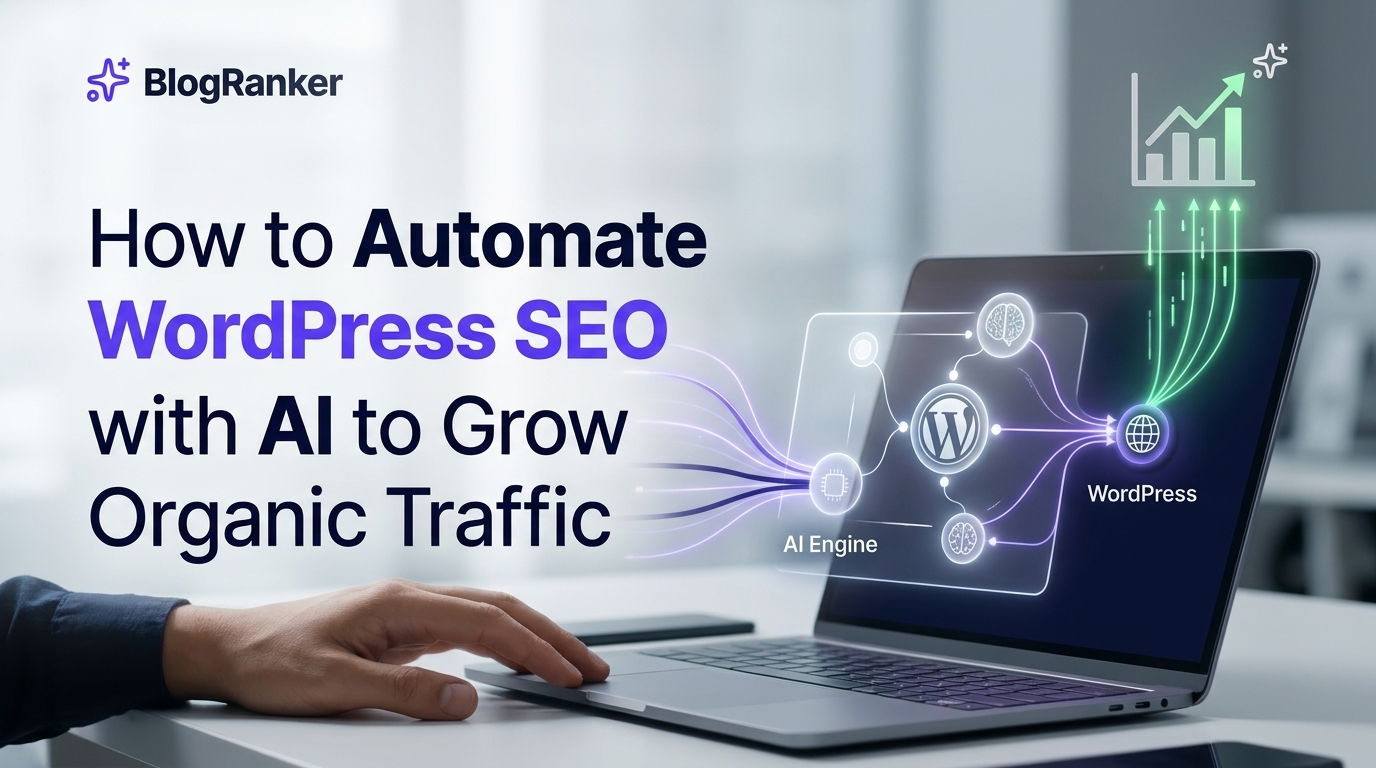
Growing a website today is no longer about who can write the best 800-word article once a week. It is about who can maintain a high volume of quality content that satisfies both human readers and search engine algorithms at scale. If you are still manually drafting every post, you are falling behind competitors who use AI to handle the heavy lifting. This guide shows you exactly how to build a production line that generates, optimizes, and publishes SEO-rich content directly to WordPress without you lifting a finger.
Table of Contents
- The Evolution of WordPress Content Strategy
- Building Your SEO Automation Tech Stack
- Setting Up Your AI Content Pipeline
- Maintaining Brand Voice and Quality Control
- Automating On Page Elements and Media
- Internal Linking and Site Authority Automation
- Measuring Success and Generative AI Optimization
- Frequently Asked Questions
The Evolution of WordPress Content Strategy
In the past, SEO was a manual grind of keyword research, drafting, editing, and formatting. Today, the landscape has shifted toward high-frequency publishing and semantic depth. To win in 2026, your WordPress site must behave like a digital media house rather than a static blog. Manual content creation is a bottleneck that prevents you from covering the thousands of long-tail keywords that actually drive conversions.
When you compare manual SEO vs automated AI content growth, the difference in velocity is staggering. An automated system can cover an entire niche in the time it takes a human to write three articles. This volume allows you to dominate the Topical Authority metric, which search engines use to decide if you are an expert in your field.
To see how businesses are scaling outside of just SEO, check out these Claude AI Prompts You Can Use to Build a Global Service Business Right Now to see the potential of AI-driven operations.
Building Your SEO Automation Tech Stack
You need a reliable set of tools that communicate with each other to create a seamless workflow. The goal is to move from a raw idea to a published WordPress post without manual intervention. Your stack should include an AI writer, a keyword research tool, and a bridge to connect them to your WordPress site.
| Feature | Traditional SEO Method | Automated AI SEO Method |
|---|---|---|
| Keyword Research | Manual spreadsheets | API-driven semantic clustering |
| Content Creation | Freelance writers | Advanced LLMs (GPT-5/Claude 3.5) |
| Formatting | Manual Gutenberg editing | Markdown to HTML automation |
| Image Sourcing | Stock photo hunting | AI-generated brand-aligned images |
| Internal Linking | Manual link searching | Automated anchor text injection |
| Cost per Post | $50 - $200 | $1 - $5 |
Selecting the right platform is the most important step in this process. Many users find that they can how to automate WordPress SEO tasks with one single AI content generator rather than managing five different subscriptions. This consolidation reduces the risk of API failures and keeps your billing simple.
For those interested in creative niches, these 11 Unique AI Coloring Book Prompts to Create Viral Amazon KDP Low Content Books demonstrate how AI can handle diverse content types beyond standard articles.
Setting Up Your AI Content Pipeline
The pipeline starts with data. You cannot automate content if you do not know what to write about. Use tools that allow for bulk keyword exports. You want to look for clusters of keywords rather than individual terms. Once you have a list of targets, these can be fed into an AI agent that understands search intent.
Your automation should handle the entire structure. A high-ranking post in 2026 needs a logical hierarchy: H1 for the title, H2 for main points, and H3 for supporting details. The AI must be instructed to use these tags correctly to ensure the WordPress REST API can parse the content without formatting errors. This structured approach is what allows you to compete with larger media sites.
Maintaining Brand Voice and Quality Control
One fear about automation is the loss of a human touch. However, modern LLMs can mimic a specific brand voice if given the right parameters. You should provide your AI with a style guide that includes your preferred tone, sentence length, and vocabulary. This prevents the output from sounding like a generic robot and keeps your audience engaged.
Quality control can also be automated. You can set up a secondary AI check that reviews the generated text for factual accuracy and SEO compliance before it hits the "Publish" button. This two-step process ensures that your automated content meets the high standards required to rank on page one. It is about building a system that thinks like an editor.
Automating On Page Elements and Media
A blog post is not just text. It needs meta descriptions, alt text for images, and featured graphics. Automated AI content creation platforms now handle these elements by default. When the text is generated, the AI also produces a 150-character meta description that includes the primary keyword to improve click-through rates from search results.
Images are often the biggest bottleneck in manual publishing. By using DALL-E 3 or Midjourney via API, your workflow can generate a unique, brand-aligned featured image for every post. This increases the visual appeal and helps with Image Search SEO. Having a unique image for every post also reduces your reliance on overused stock photos that can hurt your brand credibility.
Internal Linking and Site Authority Automation
Internal links are the circulatory system of your website. They help Google crawl your site and distribute PageRank to your most important pages. Manually adding these links to every new post is tedious. Modern automation tools can scan your existing library and how to automate internal linking strategy to boost rankings by inserting relevant links into new content automatically.
This process ensures that no page on your site becomes an "orphan" page with no incoming links. By systematically linking back to your pillar content, you signal to search engines which pages are the most important. This structure is vital for growing organic traffic because it keeps users on your site longer, which is a positive ranking signal for the algorithm.
Measuring Success and Generative AI Optimization
In 2026, SEO is not just about ranking in Google. You also need to optimize for Generative AI Optimization (GAIO). This means ensuring your content is clear and structured enough to be cited by LLMs like ChatGPT and Google Gemini. When these AI models answer user queries, they look for authoritative sources to reference. Automation allows you to publish the volume of data needed to become one of those sources.
Track your progress using Search Console and AI-specific tracking tools. Look for your "Citation Rate" alongside your traditional rankings. If your automated content is being used as a source for AI-generated answers, you are winning. This multi-channel visibility is the goal of any modern digital marketing strategy, especially for SaaS founders and SEO agencies.
Frequently Asked Questions
Can automated AI content get my site penalized by Google? Google prioritizes high-quality, helpful content regardless of how it is created; as long as your automated posts provide value and are not spammy, they will rank.
How many articles should I publish per week with automation? Aim for 3 to 5 high-quality automated posts per week to build topical authority without overwhelming your site's crawl budget.
Do I need to code to set up WordPress SEO automation? No, most modern platforms use simple API keys or dedicated WordPress plugins to connect your AI content pipeline to your website.
Is AI content better than human-written content for SEO? AI is better for scale and technical optimization, while humans are better for original research and deep emotional storytelling; a hybrid approach often works best.
Automation is the only way to stay competitive in an era where AI is accelerating the pace of information. By building a robust pipeline that handles keyword research, content generation, and publishing, you free yourself to focus on high-level strategy and business growth. Start by choosing one part of your workflow to automate today and scale from there.
Created by BlogRanker.
KEEP READING
Discover more insights and strategies


Scale your traffic today.
Stop wasting hours writing manually. Let BlogRanker generate and publish high-ranking content for you on autopilot.
Try BlogRanker Free