AI SEO Automation Platform Vs Traditional SEO Tech Stacks For Content Growth
A deep dive comparing AI SEO automation platforms to traditional tech stacks for scaling organic traffic and domain rating in 2026.
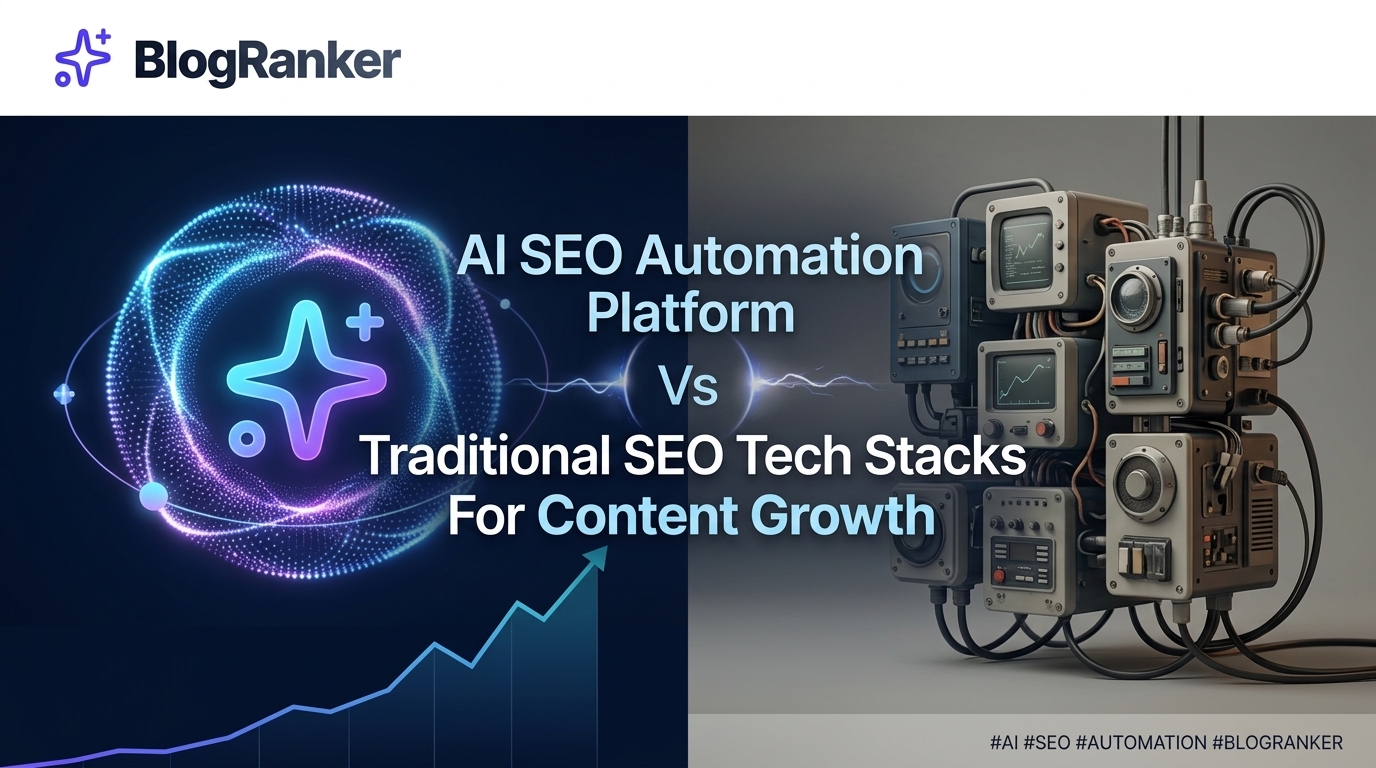
Managing a content engine in 2026 requires more than just high-quality writing. Most businesses lose hundreds of hours every month toggling between keyword research tools, manual spreadsheets, and clunky CMS interfaces. This fragmented approach creates a bottleneck that prevents high-growth startups and agencies from hitting their traffic goals. This guide breaks down why moving from a scattered tech stack to a unified AI SEO automation platform is the only way to remain competitive in an era dominated by Generative AI Optimization (GAIO).
Table Of Contents
- The Fragmentation Of Traditional SEO Tech Stacks
- Why Speed And Scale Define SEO Success In 2026
- Cost Efficiency For SaaS Founders And SEO Agencies
- Generative AI Optimization And LLM Visibility
- Technical Integration And Content Synchronization
- Comparison Of Traditional Stacks Vs AI Automation
- Frequently Asked Questions
The Fragmentation Of Traditional SEO Tech Stacks
Traditional SEO workflows are built on a series of disconnected tools. You typically start with a keyword research tool to find opportunities, move to a document editor for content creation, use a third-party optimization tool to check for keyword density, and finally copy-paste everything into a CMS like WordPress. This manual relay race introduces human error at every stage and slows down the publishing frequency needed to see real results.
When you use a fragmented stack, your data lives in silos. The person doing the keyword research might not be the one writing the content, and the person publishing the post might not know the internal linking strategy. This leads to missed opportunities and a disjointed user experience. Modern brands are realizing that they need a more cohesive system to maintain their competitive edge.
Visual identity also suffers in traditional workflows. Many teams still rely on stock photos that look generic and dated. For those looking to stand out, choosing the right image generation tool is vital. You can see how this works in this analysis of Nano Banana AI Versus Midjourney For Generating Photorealistic Brand Photos, which highlights how AI tools are replacing manual photography and stock licensing.
Why Speed And Scale Define SEO Success In 2026
In the current search environment, the volume of high-quality indexed pages is a primary driver of Domain Rating (DR). Traditional teams might produce four to eight deep-dive articles per month. In contrast, an AI SEO automation platform allows a single operator to produce hundreds of rank-ready articles in the same timeframe. This isn't about spamming the index; it's about covering every possible topical cluster with precision.
Automation platforms integrate the research and writing phases into a single motion. By removing the friction of manual drafting and editing, you can respond to trending topics or industry shifts in minutes rather than weeks. This agility is what separates market leaders from those who are constantly playing catch-up with their competitors' rankings.
One of the most overlooked parts of scaling is the architecture of the site itself. Without proper structure, new pages won't pass authority effectively. This is why internal linking automation is the key to higher search engine ranks because it ensures that every new piece of content is instantly connected to your most important pillar pages, boosting the visibility of the entire domain.
Cost Efficiency For SaaS Founders And SEO Agencies
For SaaS founders, SEO is often a secondary focus that gets neglected because of the high cost of manual labor. Hiring a full-time SEO manager and a team of freelance writers can easily cost $10,000 per month or more. SEO agency owners face a different problem: they need to scale their fulfillment without a linear increase in headcount. Each new client shouldn't require a new hire.
AI SEO automation platforms solve both problems by turning a labor-intensive process into a software-driven one. Instead of paying for five different subscriptions (Ahrefs, SurferSEO, Grammarly, Midjourney, and Jasper), you consolidate everything into one platform. This reduces the cost per article from $150 to pennies.
Creativity doesn't have to be sacrificed for efficiency. Using specific prompts can help maintain a human-like point of view even at scale. For example, using 13 Grok Prompts for POV Content Creation to Boost Engagement can help you inject unique perspectives into automated content, making it feel more authentic and less like a generic AI output.
Generative AI Optimization And LLM Visibility
Search is no longer just about Google’s 10 blue links. Users are increasingly getting their answers directly from LLMs like ChatGPT, Claude, and Gemini. If your brand is not mentioned in these AI-generated responses, you are invisible to a massive segment of your target audience. This is the foundation of Generative AI Optimization (GAIO).
To rank in AI Overviews, your content must be structured in a way that LLMs can easily parse and verify. This involves clear headings, factual accuracy, and high-intent keyword targeting. Traditional tools often ignore these nuances, focusing only on old-school ranking factors like meta tags and keyword frequency.
By staying ahead of these shifts, you ensure your brand stays relevant. Understanding how to optimize your website for Google AI overviews to increase visibility is a mandatory skill for modern marketers. Automation platforms help by automatically formatting your content to meet these new technical requirements, ensuring that every post is optimized for both human readers and AI crawlers.
Technical Integration And Content Synchronization
A major pain point in the traditional tech stack is the "Copy-Paste Tax." Moving a completed article from a Google Doc to WordPress usually takes 20-30 minutes when you account for formatting, image uploads, and adding meta descriptions. When you are trying to publish 50 articles a week, this becomes an impossible task for a human to manage without mistakes.
Modern platforms use webhooks and direct API integrations to sync content instantly. As soon as an article is generated and approved, it is pushed to your site with all formatting, internal links, and images intact. This creates a seamless bridge between your content strategy and your live website, allowing you to focus on high-level growth rather than technical chores.
Consolidating these tools is a strategic move for long-term growth. You can see the benefits of this transition by looking at the 7 best SEO automation tools to replace your fragmented content tech stack. These platforms allow you to manage the entire lifecycle of a blog post from a single dashboard, which is essential for maintaining a high output without burnout.
Comparison Of Traditional Stacks Vs AI Automation
| Feature | Traditional SEO Tech Stack | AI SEO Automation Platform |
|---|---|---|
| Workflow | Fragmented (5+ tools) | Unified (All-in-one) |
| Production Speed | 1-2 articles per day per writer | 100+ articles per day per user |
| Cost per Article | $50 - $250 (Human/Freelance) | <$1 (Automated) |
| Internal Linking | Manual / Plugin-based | Fully Automated & Strategic |
| GAIO Readiness | Poor (Requires manual updates) | High (Built-in formatting) |
| Technical Skills | Medium/High | Low (No-code / Auto-pilot) |
| Image Creation | Stock photos / Manual AI prompts | Automatic Brand-Aligned AI Images |
Scaling For The Future Of Search
As we progress through 2026, the gap between businesses using automation and those relying on manual processes will widen. Search engines are becoming faster at indexing and rewarding topical authority. If you are only covering a small portion of your industry’s search terms because of budget or time constraints, you are handing market share to your competitors.
Founders and agency owners must treat SEO as a product rather than a project. A product can be scaled through systems and automation. A project relies on individuals and manual effort. By treating your content growth like a factory line, you can achieve predictable, repeatable results that drive consistent traffic to your SaaS or client websites.
To achieve this, you need a setup that allows for custom prompts. If you want to instruct an AI to write like a specific brand persona, you need a code-based approach within your automation tool. For example:
Using prompts like the one above within an automated system ensures that even though you are producing high volumes of content, the quality remains high and the brand voice stays consistent across every single page.
Frequently Asked Questions
What is the main difference between manual SEO and AI SEO automation? Manual SEO relies on separate tools and human effort for each stage of content creation, while AI SEO automation integrates research, writing, and publishing into a single, software-driven workflow that scales much faster.
How does an AI SEO platform help with Google's AI Overviews? These platforms use specific semantic structures and clear formatting that make it easier for Google's Gemini and other LLMs to parse and cite your content as a source in their generated answers.
Can an AI SEO platform actually improve my Domain Rating? Yes, by enabling you to publish a high volume of relevant, topically-linked content, you increase your site's authority and topical depth, which naturally leads to more backlinks and a higher DR over time.
Conclusion
The choice between a fragmented traditional tech stack and an AI SEO automation platform is a choice between stagnation and growth. In 2026, the sheer volume of information being published online means that manual teams simply cannot keep up with the pace of the market. To win in organic search, you need a system that handles the heavy lifting of research, production, and technical optimization on autopilot.
By consolidating your tools and embracing automation, you free up your time to focus on product development, client relations, and high-level strategy. Stop fighting with five different subscriptions and start building a content engine that works for you 24/7.
This awesome blog post is created using BlogRanker , the best AI tool to create SEO optimized blog posts on auto pilot without lifting your finger.
KEEP READING
Discover more insights and strategies


Scale your traffic today.
Stop wasting hours writing manually. Let BlogRanker generate and publish high-ranking content for you on autopilot.
Try BlogRanker Free