AI SEO Automation Vs Manual Writing Tools For Scaling Search Engine Traffic
Discover the critical differences between AI SEO automation and manual writing tools in 2026. Learn how to scale search traffic, increase domain authority, and dominate LLM responses.
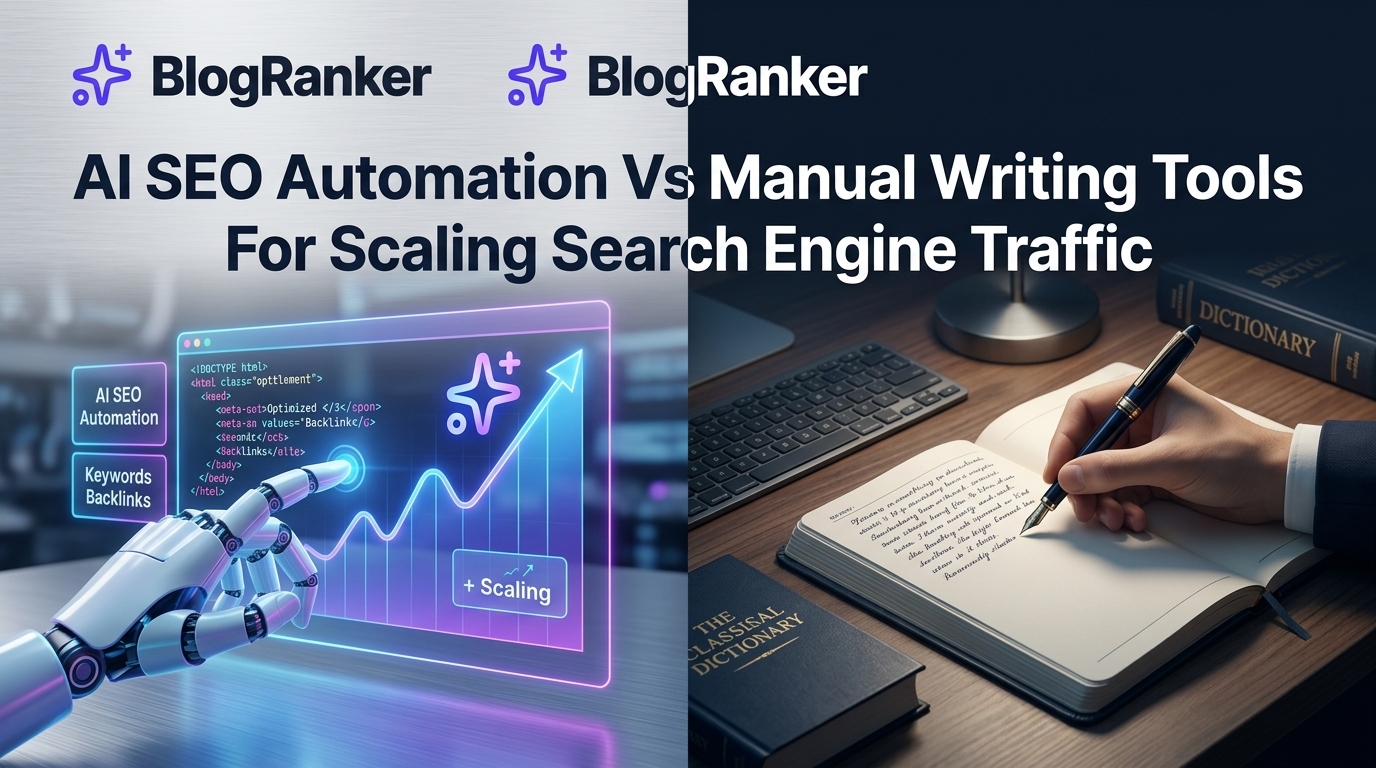
Scaling search traffic in 2026 is no longer about who can write the most words; it is about who can manage the most efficient system. If your team is still manually copy-pasting prompts into a chatbot and formatting Google Docs, you are losing the search race to competitors who have shifted to fully autonomous engines. This guide breaks down why automation is the only way to survive the current search environment and how to choose the right tech stack for your growth.
Table Of Contents
- The Efficiency Gap Between Automation And Manual AI Writing
- Cost Analysis Of Scaling Content Production
- Impact On Domain Rating And Topical Authority
- Optimizing For Generative AI Search And AI Overviews
- The SEO Tech Stack Comparison For 2026
- Transitioning To An Automated Content Strategy
- Frequently Asked Questions
The Efficiency Gap Between Automation And Manual AI Writing
Manual AI writing tools like ChatGPT, Claude, or Gemini changed the game a few years ago, but in 2026, they represent a bottleneck. Using these tools requires a human to perform keyword research, generate an outline, feed the prompt, review the output, find images, and manually upload the content to a CMS. This workflow is linear and slow. Even a skilled marketer can only manage three or four high-quality posts a day using this fragmented method.
In contrast, automated SEO content platforms handle the entire lifecycle of a blog post without human intervention. These systems pull data from search APIs, identify high-intent clusters, and generate content that is already optimized for specific ranking signals. When you how to automate your SEO strategy to rank higher on Google search result pages, you move from a linear production model to an exponential one.
Automated engines don't just write; they connect. They handle internal linking, metadata generation, and schema markup in the background. While a manual writer is still trying to figure out the right tone for a single header, an automated engine has already published ten articles that are interlinked and ready for indexing.
For businesses focused on visual growth, integrating high-quality imagery is also a part of this efficiency. You can find the 7 best free AI image generators for small business marketing without watermark to supplement your automated text and improve user dwell time metrics significantly.
Cost Analysis Of Scaling Content Production
Scaling to 100 or 500 articles per month using manual tools is prohibitively expensive. You have to account for the hourly rate of the content manager or the per-article cost of a freelancer. Even if the AI does the heavy lifting, the human management cost remains the primary expense. For a SaaS founder, this usually means hiring an expensive SEO agency or building an internal team that drains the monthly budget.
Automated platforms provide a fixed-cost solution. Whether you publish 10 articles or 100, the marginal cost of production drops toward zero. This allows startups to compete with established giants who have massive content budgets. By reducing the human labor involved in the technical aspects of SEO, you can reallocate those funds toward product development or paid acquisition.
Success in 2026 requires more than just text; it requires a unified SEO tech stack that prevents data silos. When your keyword research tool doesn't talk to your writing tool, you waste hours on data entry. Automation eliminates this friction by housing the entire strategy within one engine.
To see how this works in a creative context, look at how niche creators use 14+ Grok prompts for action figure designs to create collectible style characters. Just as they automate the design of complex physical models, SEO automation handles the complex architecture of a website's content map.
Impact On Domain Rating And Topical Authority
Topical authority is the primary currency of search engines today. Google and other search platforms no longer rank individual pages in a vacuum; they rank websites that prove deep expertise across an entire subject. Building this authority manually takes years of consistent posting. An automated engine can map out an entire niche and populate it with relevant content in a matter of weeks.
This rapid deployment of content signals to search algorithms that your site is a primary source of information. Because automated tools can identify and fill "content gaps" faster than a human researcher, they ensure your site covers every long-tail variation of a keyword. This density is what moves the needle on Domain Rating (DR).
Internal linking is the secret sauce of this process. Manually checking every new post to see where it can link back to old posts is a nightmare. However, you can learn how to build internal links automatically to ensure every new page passes authority to your "money pages." This internal structure is what keeps users on your site longer and tells Google which pages are the most important.
Understanding why topical authority is the only way to rank your business on Google today is critical for anyone trying to survive the 2026 algorithm updates. Without a massive volume of high-quality, interlinked content, your site will remain invisible behind larger, more established competitors.
Optimizing For Generative AI Search And AI Overviews
Search has shifted from "Search Engine Optimization" to "Generative AI Optimization" (GAIO). People are increasingly using LLMs like ChatGPT, Claude, and Gemini to get direct answers rather than clicking through a list of links. To be the source that these LLMs cite, your content needs to be structured in a way that AI models can easily parse and summarize.
Manual writing tools often produce "fluffy" content that lacks the structured data necessary for GAIO. Automated platforms, however, are designed with LLM training data in mind. They produce clear, authoritative, and fact-dense articles that are more likely to be featured in Google's AI Overviews. This visibility is vital for modern digital marketers who need to remain relevant in a zero-click search environment.
By focusing on high-intent keywords and clear definitions, you can ensure your brand is the one recommended by AI agents. This requires a shift in how you think about keyword research. Instead of just looking for volume, you must look for "answerability." Automated systems excel at this by analyzing how LLMs respond to specific queries and tailoring the output to match those patterns.
The SEO Tech Stack Comparison For 2026
Choosing the right tools depends on your specific goals. If you are a hobbyist writing one post a month, a manual AI writer is sufficient. If you are a founder or an agency owner looking to scale, you need an automated engine. Below is a comparison of how these two approaches stack up in the current market.
| Feature | Manual AI Writing Tools | Automated SEO Platforms |
|---|---|---|
| Production Speed | Slow (1-3 posts/day per person) | Instant (Unlimited scale) |
| Keyword Research | External/Manual | Built-in and Automated |
| Internal Linking | Manual and prone to errors | Automatic and systematic |
| CMS Integration | Manual copy-paste | Direct sync via Webhooks/API |
| Cost per Article | High (Human labor + Tool cost) | Low (Fixed subscription) |
| GAIO Ready | Rare / Needs manual tweaking | Default optimization for LLMs |
| Technical SEO | Needs separate management | Built-in (Schema, Metadata) |
Maintaining a fragmented stack is the quickest way to kill your ROI. If you are using one tool for keywords, another for writing, and a third for SEO audits, you are paying for three subscriptions and wasting time syncing data. This is why 7 proven steps to consolidate your SEO tech stack into one automated AI engine is the most effective strategy for 2026.
Transitioning To An Automated Content Strategy
Moving from manual writing to automation doesn't happen overnight, but the process is straightforward. First, you must audit your current competitors to see where they are winning. You can use specialized tools to run competitor analysis and build a 30-day automated SEO content strategy. This gives you a roadmap of which clusters to target first.
Second, stop thinking about "articles" and start thinking about "clusters." Automation allows you to dominate a niche by publishing thirty articles about a single topic simultaneously. This "blitz" approach forces search engines to recognize your authority much faster than a slow, manual drip of content.
Finally, ensure your automated engine is synced directly to your CMS. In 2026, the speed of indexing matters. If you publish content today, you want it indexed and ranking by tomorrow. Manual uploads create a lag that can cost you precious traffic during trending cycles.
For those managing multiple clients or several SaaS products, automation is the only way to maintain quality at scale. It removes the human error associated with repetitive SEO tasks and ensures that every piece of content meets the same high standard for technical optimization and readability.
If you are still on the fence, consider the manual process for a single post. You have to write a prompt like this just to get started:
Now, imagine doing that 50 times a month. With an automated engine, that prompt is handled by a sophisticated backend that knows your brand voice, your internal link structure, and the current search trends without you typing a single word.
Frequently Asked Questions
Does AI-automated content rank as well as manual content? Yes, provided the automation engine uses high-quality LLMs and incorporates real-time search data and proper SEO structure. In 2026, search engines prioritize the value and accuracy of the information over whether a human or an AI typed the keys.
Will using automated SEO tools get my site penalized by Google? No, Google's guidelines state that high-quality content is rewarded regardless of how it is produced. Automation focuses on providing helpful, reliable information that satisfies user intent, which is exactly what algorithms look for.
How many articles should I publish to see results with automation? To see a significant shift in topical authority and domain rating, aim for at least 20 to 30 high-quality, interlinked articles per month. This volume allows the algorithm to understand your site's expertise and index your content more frequently.
Can automation handle niche technical topics? Yes, modern automated platforms can pull from technical documentation and search APIs to generate highly accurate content for specific industries, including SaaS, medical, and legal niches, while maintaining a simple and readable tone.
Conclusion
The choice between manual writing tools and AI SEO automation is a choice between working in your business and working on your business. Manual tools keep you busy with chores—researching, prompting, and formatting. Automation frees you to focus on high-level strategy and product innovation while your search traffic grows in the background.
If your goal is to scale your organic growth, increase your domain rating, and ensure your brand appears in the next generation of AI-driven search results, the path is clear. Consolidate your tech stack, embrace autonomous content engines, and start building the topical authority your business deserves.
This awesome blog post is created using BlogRanker , the best AI tool to create SEO optimized blog posts on auto pilot without lifting your finger.
KEEP READING
Discover more insights and strategies


Scale your traffic today.
Stop wasting hours writing manually. Let BlogRanker generate and publish high-ranking content for you on autopilot.
Try BlogRanker Free